Wei Zhang | VP of Research and Development, Zynnovation LLC
Date: 25th June, 2026
Level: Advanced
Duration: 1 hour
Type of Course: Webinar – On Demand
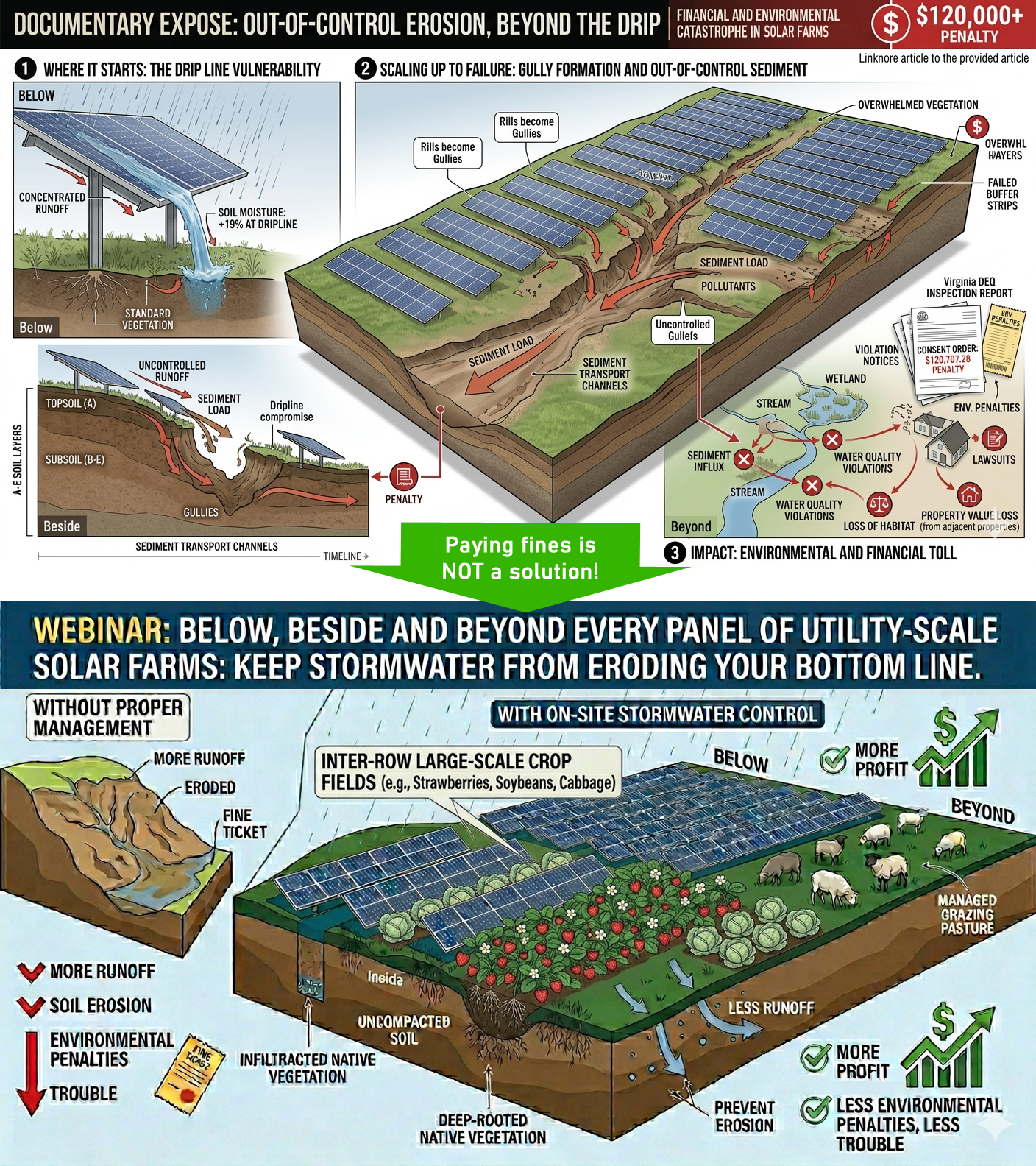
Stormwater runoff from utility-scale solar farms can be destructive. It doesn’t just erode the soil, but also the profitability when the stormwater-related operating costs and regulatory fines are considered. Low Impact Developments (LID) and Green Stormwater Infrastructure (GSI), e.g. bioswales, bioretention and infiltration basins, are often the choice for stormwater management. Originally developed for populated areas where stormwater runs off from impervious surfaces, LID/GSI is considered as the distributed systems replacing the conventional centralized stormwater infrastructures, many of which are combined with sewage systems. These LID/GSI projects may be “distributed” on the municipal level, but still locally centralized at permeable spaces like parks, right-of-ways, and parking islands. In contrast, most utility-scale solar farms are built on farmlands, forest lands or brownfields. Although the panels are impervious and the primary source of stormwater runoff, the surfaces under and beside the panels are not impermeable even the soil may be compacted by construction and operation.
Currently, LID/GSI are built on dedicated acreages of utility-scale solar farms, which does reduce the producing acreages. A novel approach is to make the “distributed” LID/GSI systems more distributed from the solar-farm scale down to the panel scale making use of the vast permeable surfaces around solar panels. By catching stormwater runoff at the dripline of each panel, stormwater can be retained, detained and infiltrated right at the panel scale. This approach improves vegetation establishment, biodiversity and soil microbiome while reducing runoff and erosion. For dual-use projects like agrivoltaics, this new approach increases crop production and reduces or eliminates the need of irrigation system. Even in semi-arid and arid areas where rainfall is not sufficient to support agricultural activities and an irrigation system is still required, this novel approach can significantly reduce the water usage. Retaining stormwater on the site can potentially reduce the size of LID/GSI and increase the usable land for energy production. In addition to the increased energy output, reduced stormwater runoff leads to lower operational costs and less regulatory fines.